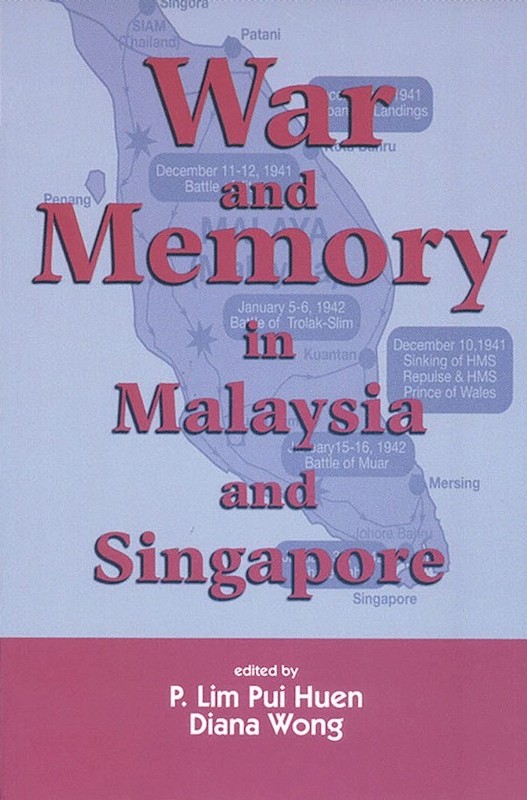
This volume consists of papers presented at a workshop on War and Memory in Malaysia and Singapore to commemorate the fiftieth anniversary of World War II, plus two additional papers. The papers reveal the importance of oral history where documentary records are lacking. The excavation of memory covering classes, communities and localities throws up the multiplicity and complexity of memory, deeply layered and richly textured, especially because of the complex nature of society in Malaysia and Singapore. As the generation of those who fought in the war and suffered as its victims is gradually passing, this volume of reflections on war and memory is timely.
Preface
In October 1995, the Institute of Southeast Asian Studies held a workshop on War and Memory in Malaysia and Singapore to commemorate the fiftieth anniversary of the end of World War II. With the exception of two additional papers, this volume comprises the papers presented at this workshop.
Interest in the war at the Institute dates back to 1973, when an oral history project on the war and its aftermath was inaugurated, given the value of oral history for this period on which there are a few documentary records. The interviews conducted then included those with Mamoru Shinozaki, a Japanese civilian official in the Syonan administration; Yap Cheng Geck, a banker; and Philip Hoalim, leader of Singapore’s first political party, the Malayan Democratic Union. This volume is a continuation of this early pioneering work done at the Institute on the war.
In the early interviews, the memories of the elite were tapped. In this volume, the excavation of memory has been extended further, to cover different classes, communities and localities. What is revealed is the multiplicity and complexicity of memory; deeply layered and richly textured, because of the complex nature of society in Malaysia and Singapore. The papers also show that memory is contested terrain, and that when the war ends, the battle for memory begins.
Fifty years after the end of World War II, the generation of those who fought in the war and suffered as its victims, is gradually passing. To the new generations, the war is a distant memory passed down from the stories of their parents and grandparents, learnt from lessons in school, or read from books. The reflections on war and memory contained in this volume would thus appear to be timely.
We would like to thank the contributors for the effort put into the revision of the papers after the workshop. This volume is offered as a tribute to two former Directors of the Institute: Professor Josef Silverstein, who was Director from 1970 to 1972, and the late Professor Kernial S. Sandhu, Director from 1972 to 1992, who initiated and fostered oral history work at the ISEAS on the war and its aftermath.
The Editors
List of Contributors
Abu Talib Ahmad
Cheah Boon Kheng
P. Lim Pui Huen
Ng Siew Ai
P. Ramasamy
Kamalini Ramdas
Naimah S. Talib
Wang Gungwu
Diana Wong
Yeo Song Nian
Brenda Yeoh