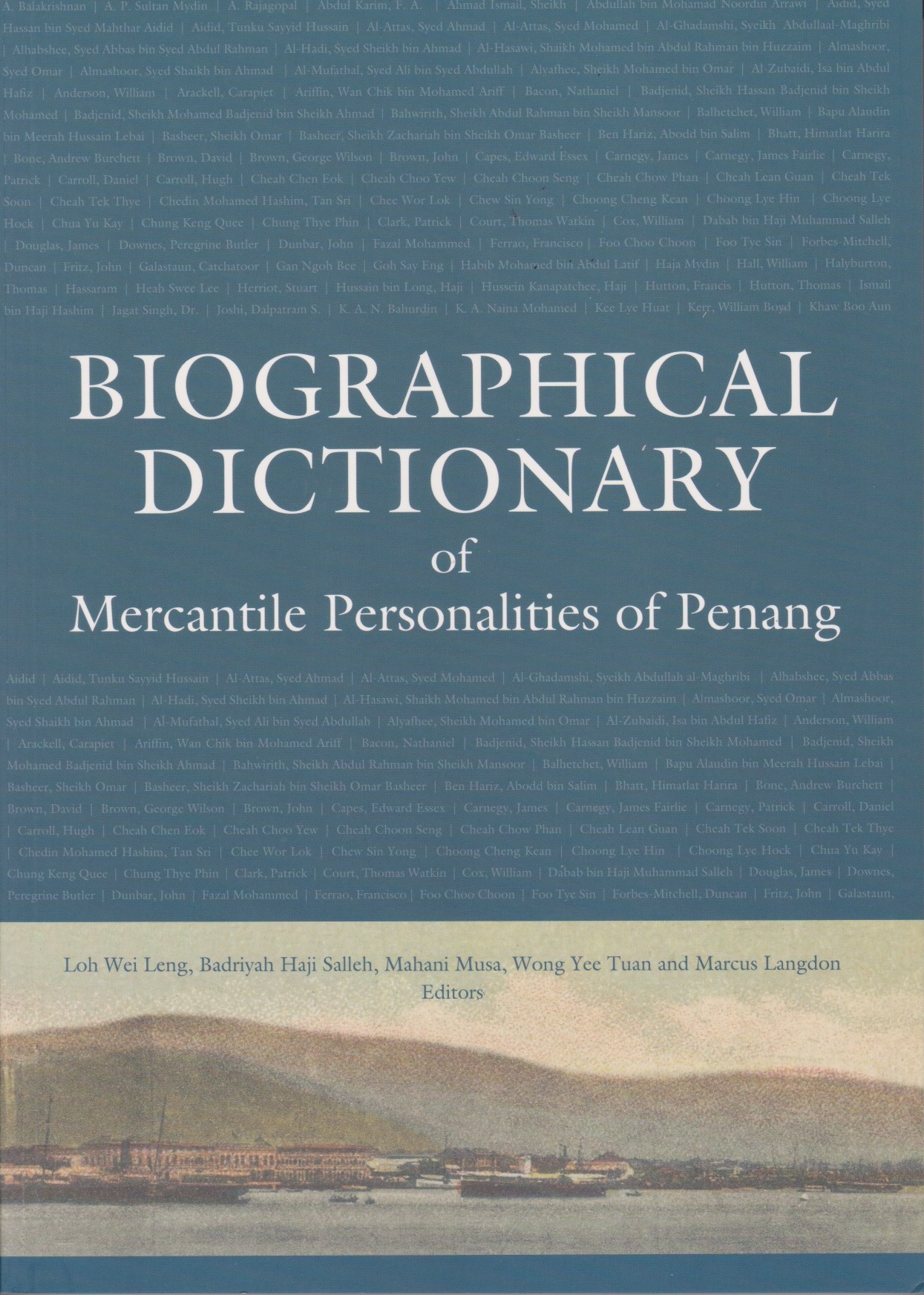
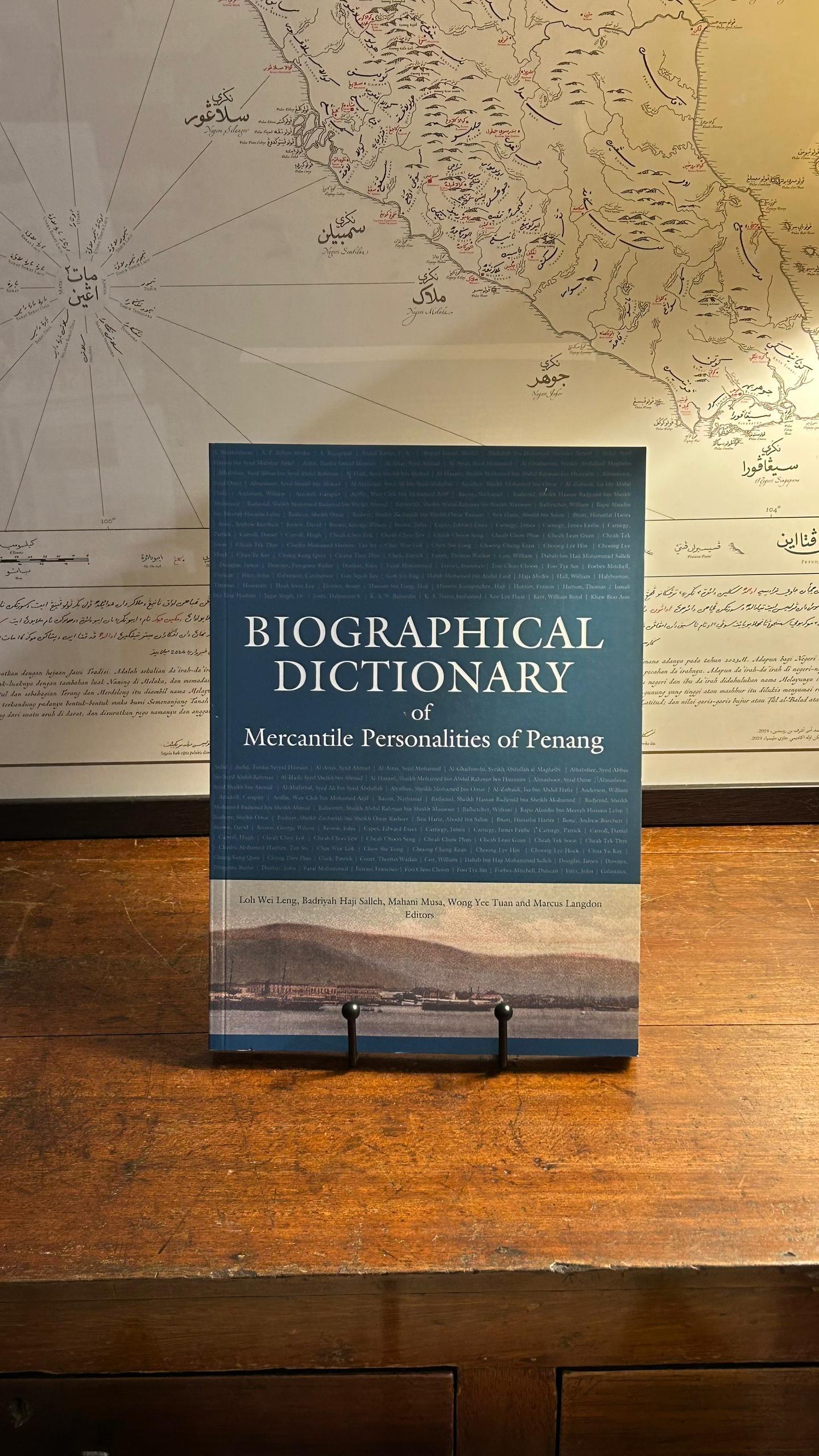
The trader and business community has formed a major pillar since the late 18th century of the city, when Penang was made an entrepôt. The Biographical Dictionary of Mercantile Personalities of Penang, which focuses on the mercantile male personalities who pioneered the growth of George Town from the end of 18th century up to the mid-20th century, is the first of its kind.
It includes community and political leaders, civil servants, academicians, religious teachers and artists, and among them, a few prominent women. The book highlights the life of merchants and business people from all communities, including the Acehnese, Arabs, Armenians, British, Chinese, Eurasians, Indians, Malays, Parsees and Scottish. It has been prepared with great care, thanks to the contribution of twenty authors. The entries are introduced by an overview of the historical development of the island since the coming of the Portuguese to Malacca.
Although this dictionary is still far from being exhaustive, as the editors admit, it does great service to the historians who want to deepen their knowledge on these personalities and their part in the making of Malaya and even Southeast Asia.
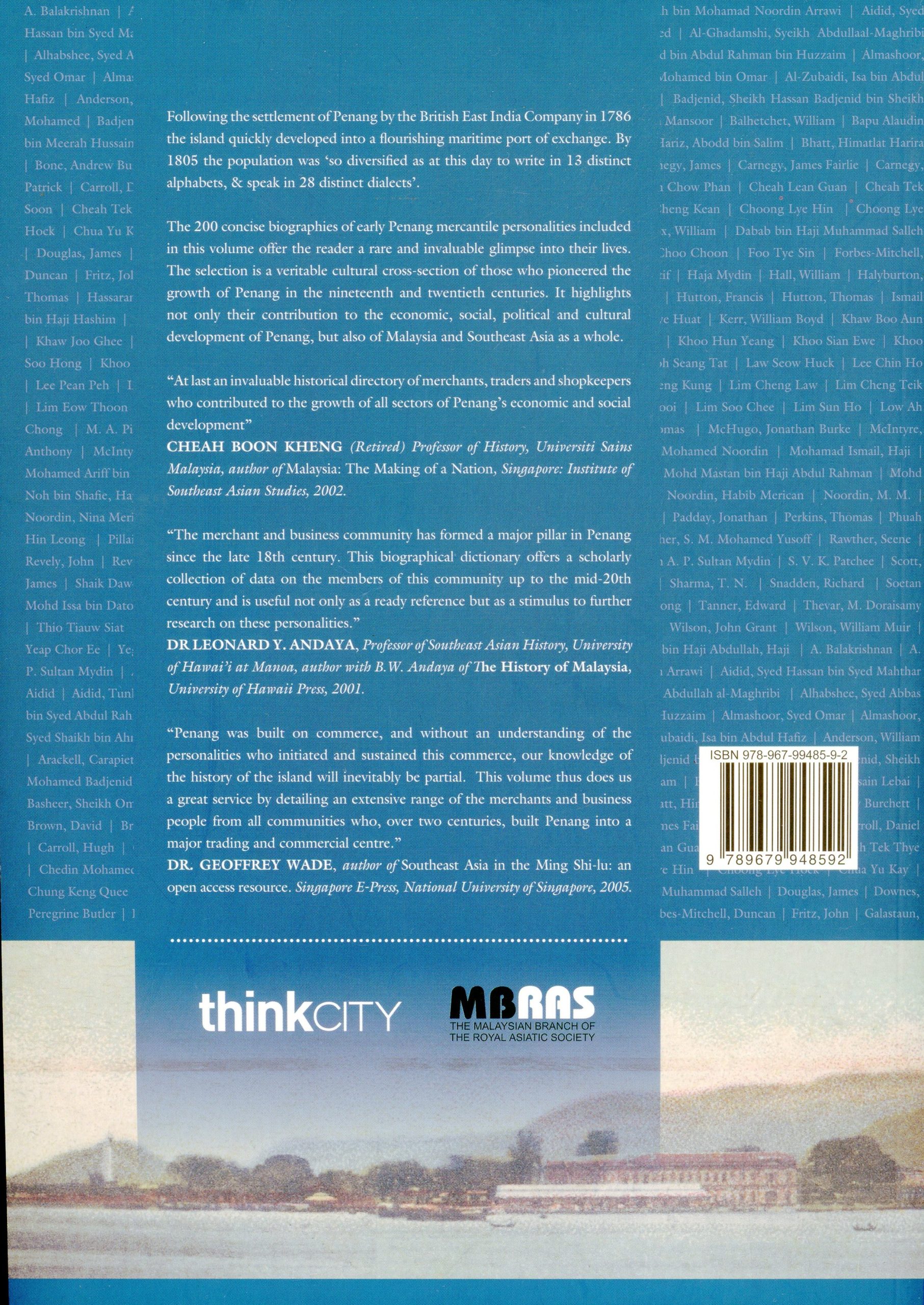
Back cover
Following the settlements of Penang by the British East India Company in 1786 the island quickly developed into a flourishing maritime port of exchange. By 1805, the population was ‘so diversified as at this day to write in 13 distinct alphabets, & speak in 28 distinct dialects’.
The 200 concise biographies of early Penang mercantile personalities included in this volume offer the reader a rare and invaluable glimpse into their lives. The selection is a veritable cultural cross-section of those who pioneered the growth of Penang in the nineteenth and twentieth centuries. It highlights not only their contribution to the economic, social, political and cultural development of Penang, but also of Malaysia and Southeast Asia as a whole.
“At last an invaluable historical directory of merchants, traders and shopkeepers who contributed to the growth of all sectors of Penang’s economic and social development”
CHEAH BOON KHENG (Retired) Professor of History, Universiti Sains Malaysia, author of Malaysia: The Making of a Nation, Singapore: Institute of Southeast Asian Studies, 2002.
“The merchant and business community has formed a major pillar in Penang since the late 18th century. This biographical dictionary offers a scholarly collection of data on the members of this community up to the mid-20th century and is useful not only as a ready reference but as a stimulus to further research on these personalities.”
DR LEONARD Y. ANDAYA, Professor of Southeast Asian History, University of Hawai’i at Manoa, author with B.W. Andaya of The History of Malaysia, University of Hawaii Press, 2001.
“Penang was built on commerce, and without an understanding of the personalities who initiated and sustained this commerce, our knowledge of the history of the island will inevitably be partial. This volume thus does us a great service, by detailing an extensive range of merchants and business people from all communities who, over two centuries, built Penang into a major trading and commercial centre.”
DR. GEOFFREY WADE, author of Southeast Asia in the Ming Shi-lu: an open access resource. Singapore E-Press, National University of Singapore, 2005.
Editors
Dr. Loh Wei Leng is a retired professor in history at the University of Malaya, Kuala Lumpur. Among recent publications are two chapters in Penang and Its Region. The Story of an Asian Entrepot, (NUS Press, 2009).
Dr. Badriyah Hj. Salleh, formerly of Universiti Sains Malaysia and Director of Museums, Melaka. She participated in the preparation of materials towards the application to UNESCO for the heritage listing of Penang and Melaka.
Dr. Mahani Musa, Associate Professor of the History Section, Universiti Sains Malaysia. Among her recent publications is Malay secret societies in the northern Malay states, 1821-1940s (2007).
Dr. Wong Yee Tuan is a PhD graduate from the Australian National University. His thesis was on “The Big Five Hokkien Families of Penang and their regional networks, 1800s – 1900s” (2007). He is head of the Penang Studies Programme at the Penang Institute.
Marcus Langdon is an Australian-based researcher who specializes in the early history of Penang under the East India Company 1786-1858. His extensive research conducted over the past decade relies heavily on original documentation such as the Straits Settlements Records. His most recent publication is Penang: the Fourth Presidency of India 1805-1830, Volume One: Ships, Men and Mansions (2013).