The original Langsuir (whose embodiment is supposed to be a kind of night-owl) is described as being a woman of dazzling beauty, who died from the shock of hearing that her child was stillborn, and had taken the shape of the Pontianak. On hearing this terrible news, she “clapped her hands,” and without further warning “flew whinnying away to a tree, upon which she perched.” She may be known by her robe of green, by her tapering nails of extraordinary length (a mark of beauty), and by the long jet black tresses which she allows to fall down to her ankles- only, alas! (for the truth must be told) in order to conceal the hole in the back of her neck through which she sucks the blood of children! These vampire-like proclivities of hers may, however, be successfully combated if the right means are adopted, for if you are able to catch her, cut short her nails and luxuriant tresses, and stuff them into the hole in her neck, she will become tame and indistinguishable from an ordinary woman, remaining so for years. Cases have been known, indeed, in which she has become a wife and a mother, until she was allowed to dance at a village merry-making, when she at once reverted to her ghostly form, and flew off into the dark and gloomy forest from whence she came.
In their wild state, a Malay once informed me, these woman-vampires are exceedingly fond of fish, and once and again may be seen “sitting in crowds on the fishing-stakes at the river mouth awaiting an opportunity to steal the fish.” However may be, it seems curiously in keeping with the following charm for “laying” a Langsuir:–
“O ye mosquito-fry at the river’s mouth
When yet a great way off, ye are sharp of eye,
When near, ye are hard of heart.
When the rock in the ground opens of itself …
Then (and then only) be emboldened the hearts of my foes and opponents!
When the corpse in the ground opens of itself
Then (and then only) be emboldened the hearts of my foes and opponents!
May your heart be softened when you behold me,
By grace of this prayer that I use, called Silam Bayu.”
About the Author
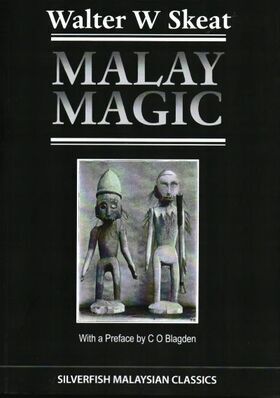
Walter William Skeat (born Oct. 14, 1866, Cambridge, Cambridgeshire, Eng.—died July 24, 1953, London) was a British ethnographer of the Malay Peninsula whose detailed works laid the foundation for later ethnographic studies of the area. Following a classical education at Christ’s College, Cambridge, Skeat in 1891 joined the civil service of the state of Selangor in the Malay Peninsula. He became interested in ideas of magic found among Malays and in the customary practices and daily life of the aborigines living in the interior.
During 1899 he carried out an expedition to Trengganu (Terengganu) and Kelantan, Malay states then under Siamese suzerainty, to collect data on Malay beliefs, traditions, and ways of life in areas not yet subjected to European influence. Illness contracted on this trip forced him to resign from the colonial service, and he spent the remainder of his life in London, serving as one of the Studeley lecturers at the British Museum from 1914 until his retirement in 1932.