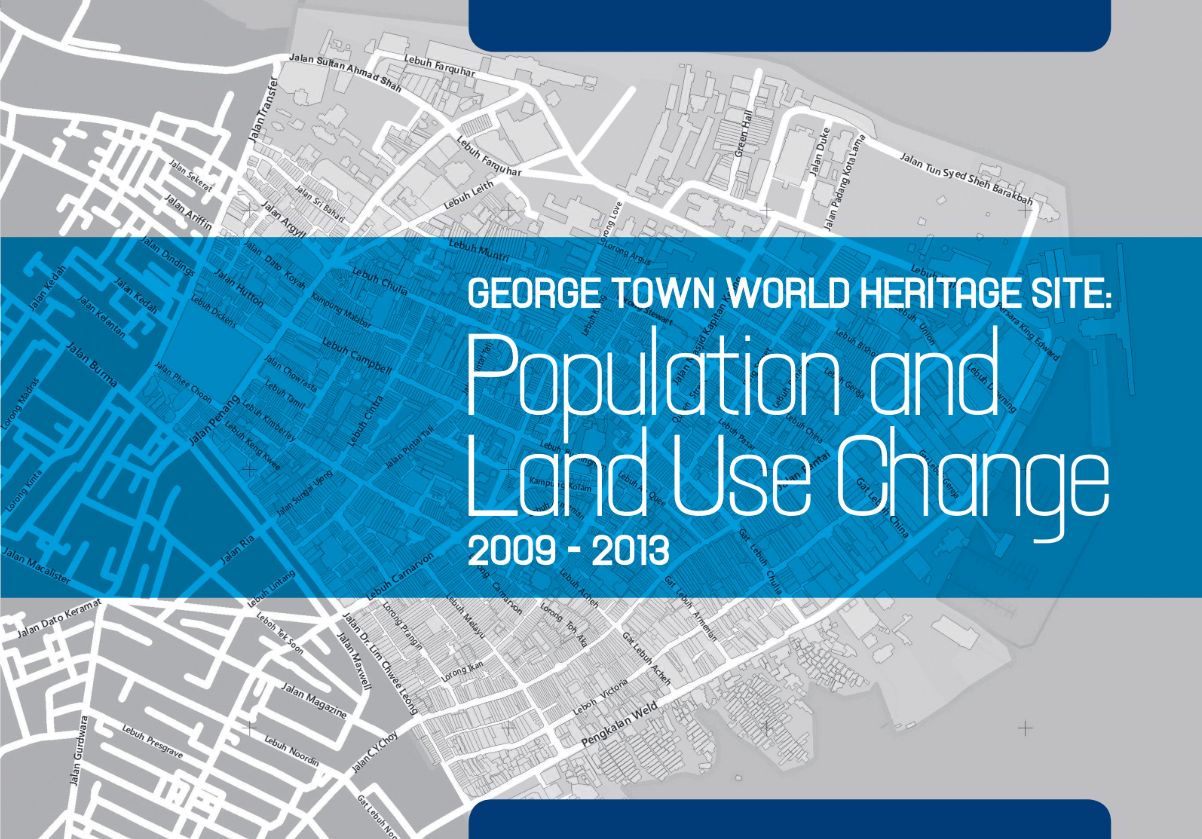

Recognising the necessity to collect baseline data on the George Town World Heritage Site, Think City Sdn Bhd (a subsidiary of Khazanah Nasional) commissioned Australian based consultancy Geografia to work in partnership with George Town World Heritage Incorporated and the Jabatan Perancangan Bandar dan Desa Penang – to undertake a population and land use census in 2009, and again in 2013.
The censuses involved a survey of every business, resident, association, education institute, government agency, street stall/market vendor and vacancy in the World Heritage Site. The data shows that the Site has undergone a number of interrelated changes – most notably population decline and economic restructuring away from household and business services towards hospitality/tourism (see Table A for a snapshot).
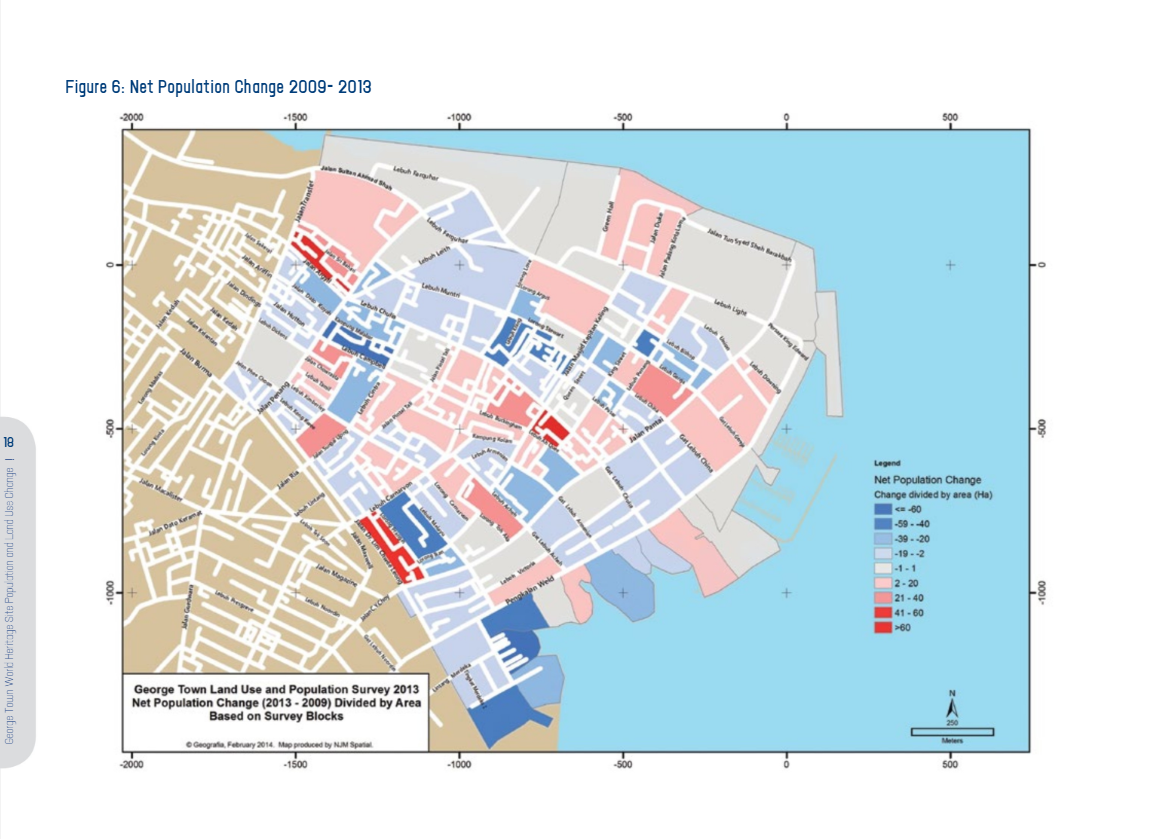
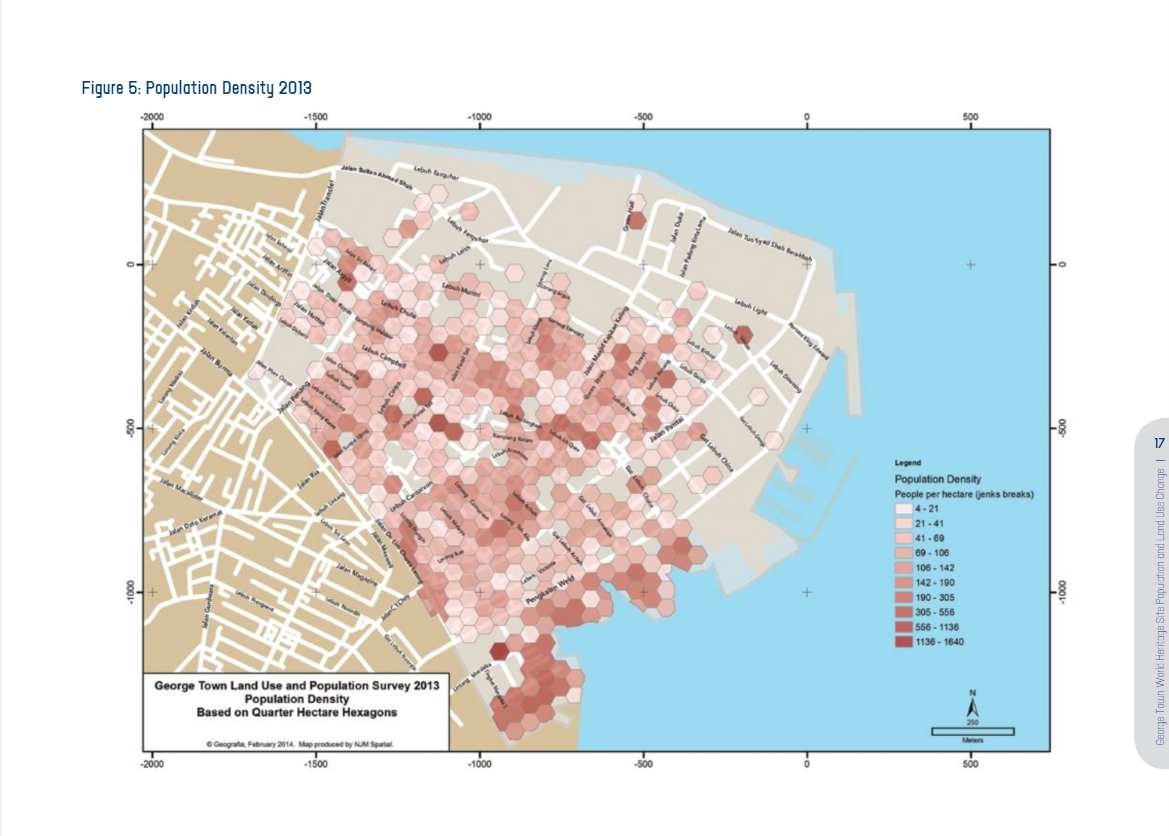
Between 2009 and 2013, approximately 360 new households moved into the Site. However, total household numbers declined by 230 (resulting in 730 fewer residents). This suggests around 590 households left the World Heritage Site over the four year period. Those who moved out were generally young families, females, older residents, renters, working outside the Site and professional households.
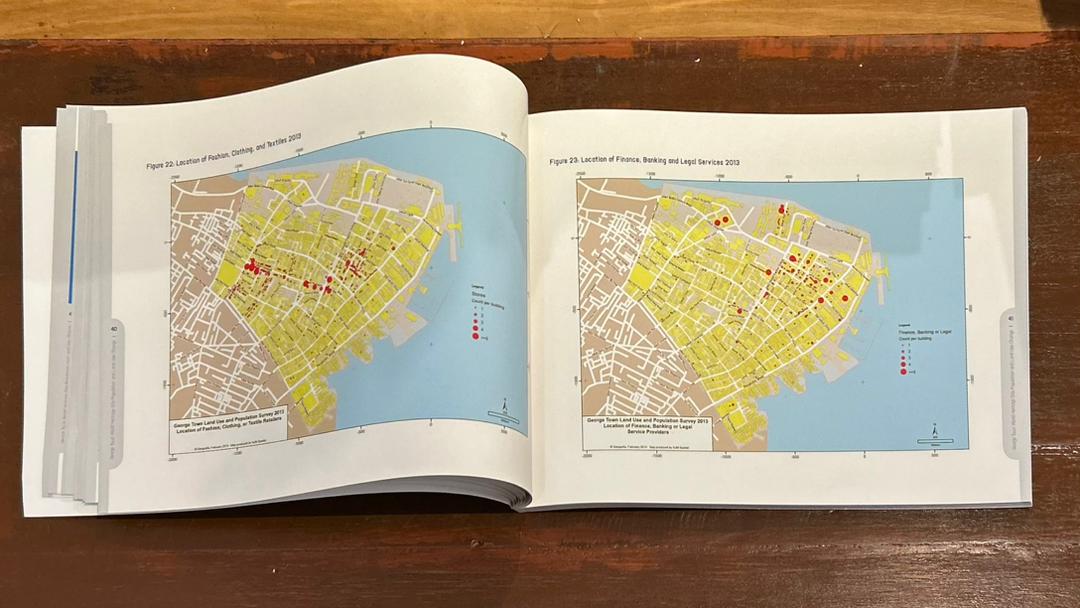
In parallel, there has been a shift in the structure of the local economy evident in an increase in tourism, hospitality and creative industry aligned services. This is best illustrated by the increase in the number of hotels (+41), restaurants/bars (+47), arts, culture and craft business (+26), travel and tourism services (+21) and fashion, clothing and textile related businesses (+19).
This shift is marked by a number of other changes including an increase in the number of migrants working and living in the Site, an associated diversification of the resident and labour force and an increase in the night time economy.
There has also been a significant physical investment across the World Heritage Site, with 221 buildings renovated in the last four years and a further 217 under renovation. These investments have attracted nearly 660 new businesses, most of which still cite proximity as the main reason for their establishment. Vacancies have gone down accordingly.
Other positive trends of note include the increase in the number of associations (from 200 to 216), suggesting an increase in social capital. There are still strong business activity clusters which can be used to inform precinct based planning. There has also been a notable increase in the proportion of residents using sustainable transport to get to work, and there are still a significant number of residents living and working in the same building.
The underlying drivers of these trends are multi-faceted. Many are evident across Malaysia and elsewhere. However, the extent of some of these changes suggest that the World Heritage Site listing itself has influenced or at least accelerated trends. This raises a number of policy questions which in the first instance require broad agreement on a strategic vision for the site and policy responses for specific population and land use issues (Table B). Part of this includes further exploratory analysis of the rich database from the two censuses in support of evidenced based policy and planning.
TABLE OF CONTENTS
INTRODUCTION
1.1 The George Town World Heritage Site
1.2 Population and Land Use Change
METHODOLOGY
2.1 Overview
2.2 Main Land Use Activity Survey
2.3 LUCSA Code
2.4 Geocoding and Floorspace Calculations
2.5 Data Accuracy and Validation
POPULATION AND LAND USE CHANGE
3.1 Land Use Activity and Floorspace
3.1.1 Land Use Activity
3.1.2 Floorspace
3.2 Residences
3.2.1 Population and Household Structure 3.2.2 Ethnicity, Language and Religion
3.2.3 Tenancy, Length of Residency, New Residency Establishment Reasons and Intentions to Stay
3.2.4 Employment
3.2.5 Summary
3.3 Labour Force
3.3.1 Labour Force Structure
3.3.2 Jobs Density and Spatial Change
3.3.3 Summary
3.4 Businesses
3.4.1 Business Type
3.4.2 Business Location Spatial Patterns
3.4.3 Tenancy, Length of Establishment, New Business Establishment Reasons and Intentions to Stay
3.4.4 Summary
3.5 Hotels and Tourist Accommodation
3.5.1 Hotel Type
3.5.2 Hotel Location
3.5.3 Visitor Type and Occupancy
3.5.4 Tenancy, Length of Establishment, New Hotel Establishment Reasons and Intentions to Stay
3.5.5 Summary
3.6 Education Institutes
3.6.1 Education Institute Location, Employees and Students
3.6.2 Summary
3.7 Government Agencies
3.7.1 Government Agency Location and Employees
3.7.2 Summary
3.8 Clans, Not for Profits, Religious Associations and/or Political Organisations (Associations)
3.8.1 Association Location Employees and Volunteers
3.8.2 Tenancy, Length of Establishment, New Association Establishment Reasons and Intentions to Stay
3.8.3 Summary
3.9 Vacancies
3.9.1 Vacancy Type, Location and Change
3.9.2 Summary
3.10 Street Stalls and Market Vendors
3.10.1 Street Stall Market Vendor Type, Employment and Location 3.10.2 Summary
3.10.2 Summary
OPERATING HOURS
4.1 Business Operating Hours
TRAVEL TO WORK PATTERNS
5.1 Place of Work / Residence
5.2 Method of Travel to Work
BUILDING CONDITION AND RENOVATION IMPETUS
6.1 Building Condition
6.2 Renovation Impetus
SURVEY ACCURACY AND LIMITATIONS
7.1 Survey Limitations
7.2 Unable to Survey
7.3 Accuracy Survey
DISCUSSION AND POLICY DIRECTION
8.1 Population and Land Use Change Patterns and Drivers
8.2 Planning and Policy Direction
8.3 Concluding Remarks
ACKNOWLEDGEMENTS
APPENDIX – LUCSA CLASSES